





Frequently Asked Questions
Got a question? Browse our FAQs for straightforward answers about Loadhog and our reusable packaging solutions.
Across the supply chain, who is responsible for what aspects?
PPWR gives each economic operator a defined role. Manufacturers assess their packaging against Articles 5 to 12, hold the technical documentation and issue the Declaration of Conformity. Suppliers pass on the material information the manufacturer needs. Importers check that the manufacturer has done this before the packaging enters the EU. Distributors check the documentation exists and must not alter or damage the packaging in their care. Fulfilment service providers must handle packaging so that it can still do its job.
Are Loadhog products reusable under PPWR?
They are designed for repeated use, reconditioning and long service life, which is what Article 11 is built around. The formal classification also depends on the rotations act and on evidence that the packaging is operated in a compliant re-use system, so we describe design intent and available evidence rather than asserting a classification.
Are there cases where re-use is effectively mandatory?
Yes. Where transport packaging is used for transfers between sites of the same business, between linked enterprises, or for business-to-business deliveries within a single Member State, reusable packaging within a re-use system is required rather than being part of a percentage target. This is the part of the reuse rules that most often changes a customer's plan. Commission guidance on the products in scope is due by 12 February 2027.
Are there exemptions, and do the rules differ for contact-sensitive packaging?
Yes to both. Contact-sensitive packaging (food, medical, etc) has its own percentages and specific exemptions, which is why the figure for food-contact applications is not the same as the figure for general transport packaging. Exemptions apply directly, but the manufacturer has to substantiate them in the technical documentation, and the list is due to be reviewed from 1 January 2028.
Are your products really as durable as you claim?
Absolutely, we put every design through rigorous in-house testing that goes well beyond industry standards. Our pallet lids, totes and rolling containers are built to survive thousands of trips, and because we own the manufacturing process, we can guarantee quality.
Can Loadhog operate or join a re-use system with us?
We are mapping which of our product lines are sold into which EU markets and what a compliant re-use system would need to look like for each, including third-party pooling and washing partners. We can discuss participation, but we are not yet stating that a Loadhog-operated system is in place.
Can you confirm your products are free from restricted substances?
Loadhog collects and holds supplier declarations and material safety data for the polymers and additives we use. While we do not provide a detailed listin gby supplier, our material validation records are summarised in a Materials Master List so that substance information can be provided upon request. We confirm the position for a specific product reference rather than making a portfolio-wide statement.
Can you make custom sizes or completely bespoke solutions?
Our in-house design engineers work directly with customers to create tailored products – whether that's a special-size pallet lid, a hybrid rolling container for awkward loads, or a full custom sleeve system. We'll prototype, test and refine until it's perfect for your operation.
Can you tell us the grade of a product now?
Not definitively, and no supplier can. Grades depend on EU criteria and an assessment methodology that have not been adopted. loadhog currently assesses our product lines against the draft framework so that grading can be applied as soon as the criteria are published. These current estimations are included in out Product Life Cycle Assessment process.
Can you tell us the recycled content of a product today?
Loadhog can share our current estimation about the material used in a given product line and the certification our suppliers provide. We are not stating a verified PPWR percentage until the EU calculation and verification method is published, because a figure calculated another way will not be accepted as evidence until 2027.
Do material sorting labels apply to transport packaging?
The material sorting label requirement does not apply to transport packaging or to packaging within a deposit and return system. Deposit and return packaging has its own labelling rule covering clear return instructions. However, Loadhog is working to include Marking & Labelling best practice to provide product information, material handling instruction, and proper waste management practices to meet requirements for Design for Recycling and Reusability targets.
Do you need an authorised representative in the EU?
Producers established outside a Member State where they place packaging on the market should appoint an authorised representative (AR) or producer responsibility organisation (PRO) for extended producer responsibility in that State.
Do your solutions work with automated warehouses and AGVs?
Yes, we've designed the entire range with automation in mind. The Rolling Container System, OmniMax totes and automation trays are all AGV-compatible, with precise dimensions, smooth surfaces and no sharp edges. Several of our customers run fully automated lines where our products are the only packaging that reliably integrates without modifications.
Does packaging have to be recyclable now?
Packaging placed on the EU market has to be recyclable from 12 August 2026. The harmonised way of proving it — the design-for-recycling criteria and the assessment method — is set by a delegated act due by 1 January 2028, with a transition period for manufacturers after that. Loadhog demonstrates the estimated extent of product recyclability through a Product Life Cycle Assessment.
Does PPWR apply to a UK manufacturer like Loadhog?
Yes. The Regulation applies to packaging placed on the EU market whatever its origin, so a UK manufacturer exporting into the EU must comply. It also means our EU customers and importers will ask us for evidence rather than statements.
Does PPWR require bio-based plastic?
Not at present. Article 8 requires the Commission to review the state of bio-based feedstock in plastic packaging and report by 12 February 2028; targets may follow from that review. Loadhog products are not currently made from bio-based feedstock and we make no bio-based claims.
How are the fees set?
Fees are set nationally by producer responsibility organisations and are modulated by packaging characteristics, including recyclability performance once the Article 6 criteria are in force. Better-performing packaging is intended to attract lower fees. Fees and tariffs are currently not standardised across the 27 Member States, and require detailed attention to mointor and comply.
How does recyclability affect what we pay [for eco-modulation]?
Extended Producer Responsibility (EPR) fees and tariffs are modulated by recyclability performance, so better-graded packaging attracts lower fees. Recycled-at-scale requirements apply from 1 January 2035, and recyclability is assessed for the packaging unit as well as for its components — a compliant unit with a non-compliant component will not grade well. Member States are accountable for establishing and coordinating EPR Fees, Tariffs, and timelines at this time.
How does your Rolling Container System actually work in real operations?
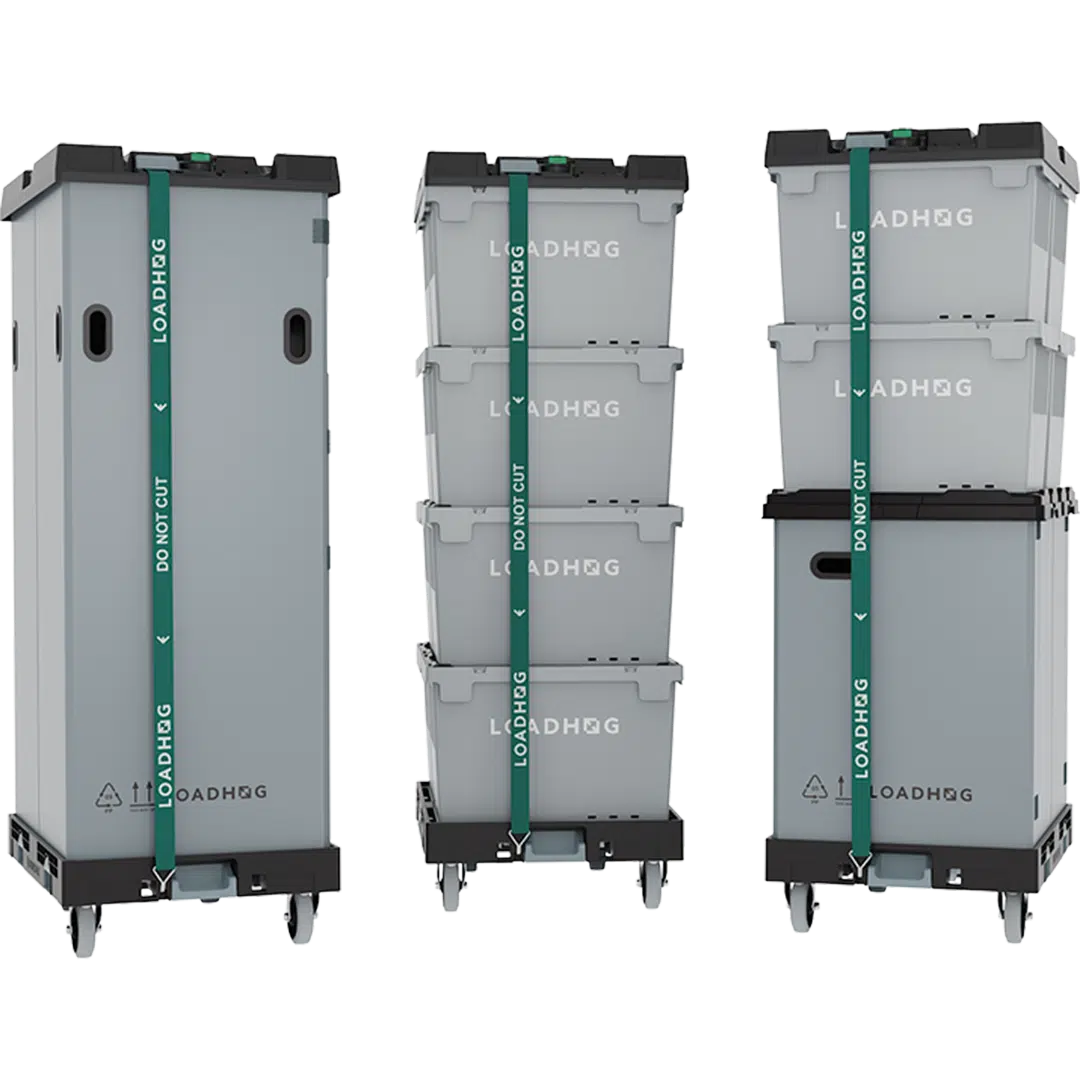
Our Rolling Container System (with the Dolly Max at its heart) is a fully modular platform that lets you handle segregated goods, bulk loads or mixed pallets in one flexible unit. You simply load the container, wheel it on and off vehicles, and the one-touch brakes and ergonomic design make it effortless to manoeuvre – even on slopes or in tight spaces. Customers regularly tell us it improves vehicle fill by up to 20%, collapses to a 3:1 return ratio and slots straight into automated guided vehicle (AGV) lines.
How is attainment of the re-use targets calculated and reported?
Attaining such targets is measured against the PPWR defined counting rules covering the types of packaging used in a calendar year. Exemptions and pooling arrangements for smaller distributors and geographies are taken into consideration. From reporting year 2030, operators in scope must measure reusable performance against single-use performance (mainly by volume) on and annual basis, reporting to designated Member State Authorities.
How is the percentage proposed to be measured?
The recycled content percentaged is proposed to be calculated as an average per manufacturing plant per calendar year, not per individual item. The EU-wide calculation and verification methodology is due by 31 December 2026, and percentages will be evidenced through supplier certification, plant-level tracking and third-party verification. Loadhog's current estimation is included in the Product Life Cycle Assessment process.
How many rotations does packaging have to achieve?
The minimum number of rotations is set by a delegated act expected by February 2027 and is likely to differ by packaging format. Until it is adopted, no supplier can state a compliant rotation figure, so we describe design life and observed service life instead.
How much can we realistically save by switching to Loadhog?
Most customers see payback within 12–18 months through reduced packaging purchases and lower transport costs.
How much recycled content will plastic packaging need?
Minimum recycled content applies from 1 January 2030, with percentages set by packaging category. Reusable transport packaging of the kind Loadhog makes falls into the category requiring 35% post-consumer recycled plastic by 2030, rising to 65% by 2040. Contact sensitive packaging require 10% by 2030 and 25% by 2038.
How quickly must you respond to a compliance request?
Information requested by a national authority must be supplied within 10 days. While not a specified requirements for customer requests, Loadhog commits to a window of 14 business days from receipt of a completed PPWR compliance request.
How sustainable are Loadhog products in practice?
All our packaging is made predominantly from recycled content, designed for circular economy loops, and we offer full take-back and swap-out schemes for old units.
How will substances of concern be identified on packaging?
Through a standardised, open, digital marking method giving the name and concentration of the substance in each material of the packaging unit. The Commission is due to set that methodology by 1 January 2030.
How will you evidence minimisation for a product?
Article 10 requires packaging to use only the minimum material needed to perform its function safely. Loadhog applies this requirement when designing each product. We record the design choices, material use and product performance in the Product Life Cycle Assessment, so the evidence can be traced for each product.
Is my item actually "packaging" under PPWR?
PPWR defines packaging by what an item does, not by what it is called as demonstrated in Article 3. Anything used to contain, protect, handle, deliver or present goods is in scope, including transport packaging and packaging components. We assess our own product lines against that definition and will tell you what we have concluded for a given product reference.
Is PPWR voluntary, or only about single-use plastic?
Neither. The EU 2025/40 PPWR is a binding Regulation with penalties set by each Member State or the Commission, and it covers all packaging materials and all packaging types, including industrial and transport packaging.
Is the August 2028 labelling date fixed?
Treat it as the earliest date rather than a settled one. The obligation applies 24 months after the relevant implementing act or from 12 August 2028, whichever is later, and that act has not yet been published. Loadhog is designing for the requirement but not finalising artwork or tooling changes until the act is adopted.
Is your packaging compostable?
No, and it is neither designed nor intended to be. The compostability requirements target specific formats such as very lightweight carrier bags, sticky labels on produce and certain single-serve items. Reusable transport packaging is not in that scope, and compostability would work against durability and repeated use (reusability).
What are the re-use targets for transport packaging?
From 1 January 2030, at least 40% of transport packaging used within the EU must be reusable and operated within a re-use system, rising to 70% from 2040. This covers pallets, crates, foldable/collapsible boxes, trays, IBCs, drums, pails and similar formats.
What are the recyclability grades?
From 1 January 2030 packaging is graded A, B or C against the EU design-for-recycling criteria. Packaging assessed below the 70% (Grade C) threshold is classed as non-recyclable and cannot be placed on the market. From 1 January 2038 only Grade A or B packaging may be placed on the market.
What does an operator putting reusable packaging on the market have to do?
Make sure a re-use system exists for it — either by joining one or setting one up — meet the requirements in Annex VI, obtain written confirmation from the participants in the system, and document the whole arrangement in the technical file. Reusable packaging is a system commitment, not just a product choice.
What does Article 5 require?
Packaging must be made so that substances of concern are minimised in its content and in the material it becomes at end of life. The aim is that nothing in the packaging undermines its reuse or recycling, or causes harm during use and treatment.
What does extended producer responsibility require?
Producers must register in every Member State where they make packaging available, report the packaging they place on that market, and contribute to the cost of its collection and treatment. The obligations apply from 12 August 2026. Article 3 sets the definitions for a Producer based on which party is accountable to placing the packaging on the market, and in which formats it is designed and made available.
What does packaging minimisation require?
Packaging must be optimised or reduced to the minimum weight and volume needed to perform its function safely, and design features that simply make a pack look larger — false bottoms, double walls, non-functional layers — are not permitted. The Commission is due to request a standard for the assessment methodology by 12 February 2027, with the requirement applying from 1 January 2030.
What does PPWR say about PFAS?
Food-contact packaging cannot be placed on the EU market above the specified PFAS (per- and polyfluoroalkyl substances, grease & water repelleent chemicals) limits from 12 August 2026, and there is no transition period for packaging placed on the market after that date.
What exactly is Loadhog, and what do you do?
At Loadhog, we're a proud employee-owned company based in Yorkshire. From rolling container systems to pallet lids and automation trays, everything we make is built to replace single-use packaging, cut carbon emissions and deliver a genuine return on investment for retailers, manufacturers, logistics providers and more.
What happens to your answers when an act is adopted?
Adoption of a delegated or implementing act is a review trigger under Section 3. The affected answers are re-evidenced, moved out of holding-line status where possible, and the change is recorded in the log in Section 10 with the date it took effect.
What has to sit behind the QR code?
For reusable packaging the digital carrier has to lead to information about reusability, the re-use system and its collection points, and tracking data such as rotations or trip counts, which may be given as averages. It must also be clear at the point of supply that the packaging is reusable rather than single-use. Open-loop systems without an operator are the exception.
What is the PPWR?
The Packaging and Packaging Waste Regulation, Regulation (EU) 2025/40, is EU law covering the whole life of packaging: the substances in it (Article 5), how recyclable it is (Article 6), how much recycled material it contains (Article 7), how little material it uses (Article 10), whether it is reused (Article 11), how it is labelled (Article 12), and who pays for it at end of life (Article 44). It replaces the 1994 Packaging Directive and applies in the same way in all 27 Member States. The current UK equivalent is the UK Producer Responsibility Obligations (Packaging & Packaging Waste) Regulations 2024/1332.
This information reflects Loadhog's understanding of Regulation (EU) 2025/40 and the guidance published by the European Commission at the date shown. It is provided for general information and is not legal advice, and it does not replace the text of the Regulation or the requirements set by individual Member States. Companies remain responsible for their own compliance obligations.
What labelling will packaging need?
Two changes matter most. "Harmonised material sorting labels" apply from 12 August 2028, and reusable packaging must carry a reusability label with a QR code or other digital data carrier from 12 February 2029. Waste receptacles carry matching labels under Article 13 so that what is on the pack and what is on the bin agree.
What makes a re-use system compliant?
The system must be documented against Annex VI Part A, packaging must be reconditioned — cleaned, inspected and restored — before each reuse, and closed-loop systems must return packaging to approved collection points. Packaging cannot be treated as reusable while being operated outside a system.
What makes packaging count as "reusable" under PPWR?
It must be designed and placed on the market to be used more than once, survive a minimum number of rotations in normal use, be emptied and reconditioned without compromising safety or hygiene, and be recyclable at end of life. Being technically durable is not enough on its own — it must also be operated inside a re-use system.
What must a distributor check before selling on?
Before making packaging available, a distributor has to verify that the producer is registered, that the required labelling is present, and that the manufacturer's and importer's documentation exists. They must also make sure the packaging is not modified or damaged while it is in their care.
When does it start, and what are the dates that matter?
The EU Regulation entered into force on 11 February 2025 and applies from 12 August 2026. The requirements then phase in: labelling for material sorting from August 2028, reusability labels and QR codes from February 2029, and recyclability grades, recycled content and reuse targets from January 2030, tightening again in 2035, 2038 and 2040.
Where are Loadhog products made, and do you ship internationally?
Everything is designed and manufactured right here in the UK, so we maintain full control over quality and lead times. We ship worldwide and have supported customers from the UK to mainland Europe, the Middle East and beyond – just get in touch, and we'll handle the logistics.
Where can I obtain PPWR compliance documentation for Loadhog products?
For our existing customers, please reach out to your regional sales team member. New customers can contact (sales emails AND/OR sustainability email).
Where do we check who is registered as a producer?
Each Member State is accountable for maintaining a national register of producers, with the Commission linking them. Some of these registers are based on existing EPR registrations, and some will be new sources. Such registers must be established within 18 months of the Regulation applying, by 12 February 2028. Until they are complete, registration status is confirmed directly with the relevant national authority.
Which role does Loadhog hold?
It depends on the route to market; we serve in different roles depending on how out products are made available on the EU Market. Where we design and place our packaging on the EU market we act as the manufacturer, with the assessment, documentation and Declaration of Conformity obligations that go with it. Where we supply packaging to another business that places it on the market, we act as a supplier and provide the technical and material information they need. We confirm the role that applies to your arrangement in writing.
Who is the producer, and does buying from Loadhog cover our EPR obligations?
The producer is the operator that first makes the packaging available on the market of a given Member State, and that is who registers and pays the fees there — usually our EU customer or importer rather than us (Loadhog), though it must be confirmed for each supply route. What we can do is provide the packaging data you need to report accurately.
Who provides the collection and return infrastructure?
Member States must ensure return and collection systems are in place from 12 August 2026 so that packaging waste can be separately collected and sent for reuse or high-quality recycling. What that looks like in practice varies by country, which is why return routes have to be designed per market rather than assumed.
Whose re-use target is it — ours or yours?
The obligation sits with the operator that uses the transport packaging, which may be a manufacturer, importer or distributor. As a supplier of reusable solutions, Loadhog can support that obligation with product information and re-use system evidence, but we do not carry your target for you.
Why can't anyone answer some of these questions yet?
Article 64 gives the Commission the power to fill in the detail of the Regulation through delegated acts. Several requirements cannot be evidenced until those acts exist — the recycled content calculation method, the design-for-recycling criteria and grades, the minimum number of rotations for reusable packaging, and the harmonised labelling specification. Any supplier claiming a firm position on these today is going beyond the published law.
Why should we switch to reusable packaging instead of sticking with single-use plastic or cardboard?
The numbers speak for themselves. Our solutions eliminate tonnes of single-use waste every year, reduce CO₂ emissions by around 88% compared with cardboard and avoid the plastic packaging tax because we use high-quality recycled materials that perform like virgin plastic.
Have a Different Question?
No problem - if you can't find what you're looking for, just get in touch using the quick and easy form below, and our team will be happy to help.


